Before the Weather App, the Sky Was an Open Book — If You Knew How to Read It
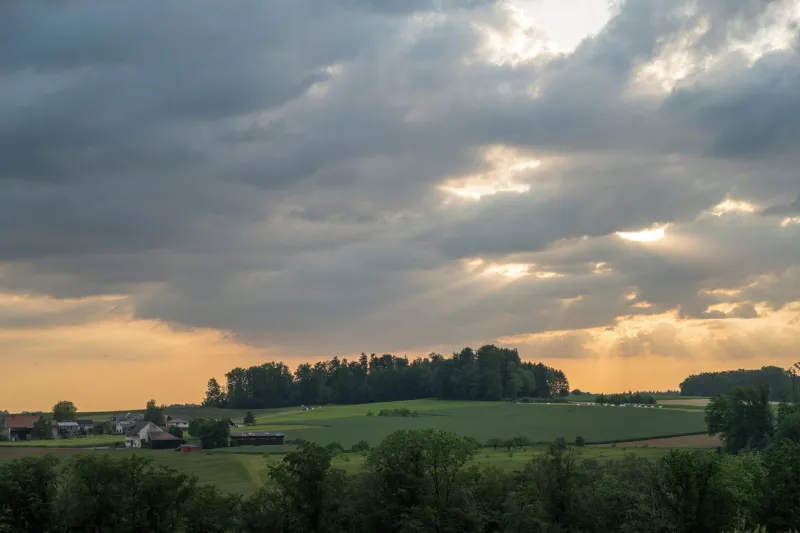
Somewhere between the second and third tap on your weather app, you've probably stopped noticing the sky entirely. And that's a shame — because for most of human history, the atmosphere was broadcasting detailed, surprisingly accurate forecasts to anyone willing to pay attention.
Before the National Weather Service issued its first official forecast in 1871, generations of Americans — farmers, Great Lakes sailors, Appalachian hunters, Plains-dwelling Indigenous nations — had already built sophisticated, field-tested systems for reading what the air was about to do. These weren't folk superstitions dressed up as science. Many of them are science, just arrived at through centuries of careful, lived observation rather than satellite imagery.
The Sky Doesn't Lie — It Just Speaks a Language We've Forgotten
Take the old rhyme most Americans have heard at least once: Red sky at night, sailor's delight. Red sky in morning, sailor's warning. Cute, right? Also, meteorologically sound. A red evening sky typically signals that dry, dust-laden air is moving in from the west — which is the direction most weather systems travel across North America. A red morning sky means that same moisture-rich air has already passed east, and the next system is building behind it.
Matthew even cited a version of this in the New Testament. It's that old.
But the old-timers went much further than catchy rhymes. Experienced farmers in the Midwest could read cloud formations the way you'd read a text message. High, wispy cirrus clouds — the feathery ones that look like someone dragged a brush across a blue canvas — were understood to signal a weather change within 24 to 48 hours. They were right. Cirrus clouds are often the leading edge of an approaching warm front, sometimes appearing a full day before the rain arrives. Modern meteorology confirmed what generations of corn growers already knew by habit.
Animal Behavior as Atmospheric Data
It wasn't just the sky. The living world around a farm or fishing village was constantly transmitting atmospheric information, and people knew how to receive it.
Cows lying down in a field before rain wasn't just a barn joke — it's a behavior that researchers have since linked to falling barometric pressure, which cattle appear to sense before humans do. Seagulls flying inland rather than out over the water often precedes coastal storms. Woolly bear caterpillars, whose banded coloring was long used by New England farmers to predict winter severity, have been studied seriously enough that scientists still debate whether the folklore holds up.
Native American communities across the continent developed some of the most nuanced observational frameworks of all. The Farmers' Almanac — which has been published continuously since 1818 — drew heavily on Indigenous seasonal knowledge, particularly around reading plant behavior and animal migration timing as proxies for incoming seasonal shifts. Cherokees tracked the blooming cycles of certain wildflowers as planting guides. Lakota hunters read wind direction and cloud behavior on the Great Plains with a precision that let them anticipate bison movement.
These weren't guesses. They were pattern libraries built across lifetimes and passed down through generations.
The Science That Caught Up to the Observation
What's remarkable isn't just that these techniques worked — it's how well they worked. A 2008 study published in the Bulletin of the American Meteorological Society examined traditional weather proverbs from seafaring cultures and found that a significant number held up under empirical scrutiny. The ring around the moon predicting rain? That halo is caused by light refracting through ice crystals in high-altitude cirrus clouds — the same clouds that precede frontal systems. The proverb works because the physics work.
The smell of rain before it arrives — that distinctive earthy scent called petrichor — was actually identified and named by scientists only in 1964, decades after rural Americans had already been using it as a reliable storm signal for generations. Country folks knew the smell meant rain was coming. Scientists just hadn't gotten around to explaining why yet.
What We Traded Away
Here's the uncomfortable part: when we outsourced weather awareness to apps and broadcast forecasts, we didn't just stop reading the sky. We stopped noticing it. And that perceptual gap has real consequences.
People who grew up reading the atmosphere developed a kind of ambient situational awareness that modern life has largely erased. A farmer in 1920s Kansas didn't just know a storm was coming — they understood how it was coming, from which direction, how fast, and roughly how severe. That distinction mattered enormously when you had livestock to shelter, crops to harvest, or a boat to bring in.
Today, we check an app that tells us there's a 60% chance of afternoon showers. We have almost no idea what the sky itself is doing.
Some of this knowledge is being deliberately preserved. Groups like the Cloud Appreciation Society have tens of thousands of members who study cloud formations seriously. Farmers using regenerative and traditional agricultural methods are relearning atmospheric reading as part of land stewardship. And in coastal communities, old-timers still teach younger fishermen how to read the water's color and wave behavior as storm indicators.
The Forecast You Carry Everywhere
The good news is that the sky hasn't changed. It's still broadcasting. The cirrus clouds are still arriving 36 hours before the front. The animals still feel the pressure drop before you do. The ring around the moon still means what it always meant.
All of this is freely available, requires no subscription, and works even when your phone is dead.
Next time you step outside, try something different: look up before you look down at your screen. The atmosphere has been giving free forecasts for longer than any app has existed — and the signal is still strong, if you remember how to tune in.