A Piece of Paper That Outlasts Every Email You've Ever Sent
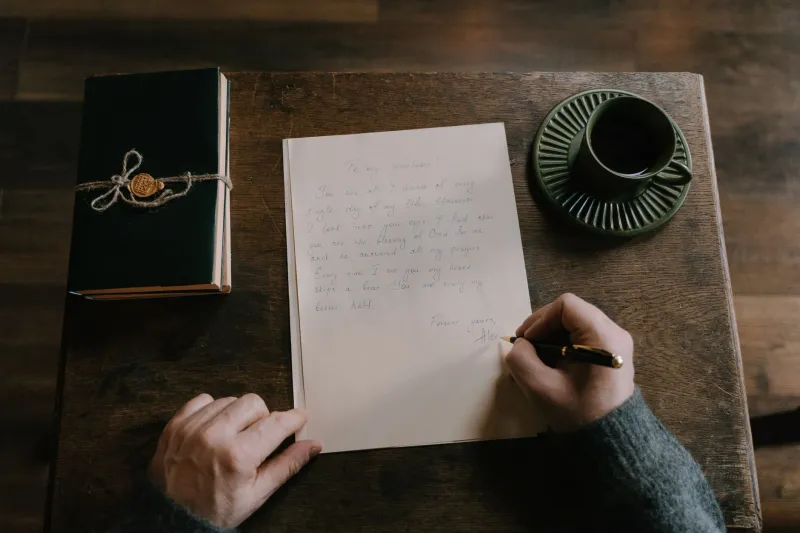
Somewhere in a drawer, tucked between old receipts and forgotten coupons, there's probably a handwritten note you've kept for years. Maybe it was from a grandmother, a mentor, or someone who showed up at exactly the right moment. You didn't keep their texts. You didn't screenshot their emails. But that piece of paper — slightly creased, ink a little faded — you held onto.
That's not nostalgia. That's psychology.
The Surprising Science of Writing by Hand
Researchers at the University of Texas and Wharton School have both studied what happens when people receive handwritten correspondence versus typed messages. The findings are pretty striking: handwritten notes are perceived as significantly more personal, more effortful, and more emotionally meaningful — even when the content is nearly identical.
One study found that recipients of handwritten thank-you notes rated the sender as warmer, more sincere, and more competent than those who received the same message via email. Competent. That one's interesting. We tend to think of handwriting as soft or sentimental, but it actually signals something about your character — that you slowed down, that you paid attention, that the other person was worth the friction.
There's also something happening in the brain of the writer. Studies on motor memory suggest that the act of physically forming letters engages deeper cognitive processing than typing. You're not just transcribing a thought — you're inhabiting it. That's why what ends up on the page often feels more considered, more honest, less like a template.
The High-Performers Who Never Stopped
Here's where it gets quietly fascinating: some of the most effective people in American business and public life never abandoned the handwritten note. They just stopped talking about it.
Warren Buffett has been known to send handwritten letters to business associates and employees for decades. Barbara Bush made personal correspondence a cornerstone of her public identity. Countless hiring managers and executives quietly report that a handwritten thank-you after a job interview — rare as it is now — almost always gets noticed.
One executive recruiter told a journalist a few years back that in fifteen years of placing candidates, she'd seen handwritten follow-up notes exactly eleven times. Every single one of those candidates got called back.
That's not a coincidence. It's a signal — and in a sea of identical LinkedIn messages and copy-pasted follow-ups, a signal is everything.
What We Gave Up When We Went Digital
There's a texture to handwritten correspondence that digital communication genuinely cannot fake. The slight slant of someone's cursive. The place where the pen pressed harder because they were making a point. The choice to use a card with a cardinal on it because they remembered you mentioned birds once.
These are not small things. They are, in fact, the entire point.
When we shifted to digital-first communication in the early 2000s, we gained enormous efficiency. Instant delivery, searchable archives, no postage required. But somewhere in that trade, we quietly surrendered the markers that told another person: I thought about you specifically, not just about what I needed to say.
Email optimized for the sender. A handwritten note optimizes for the recipient.
The Memory Effect Nobody Talks About
Here's the part that should make you rethink your communication habits entirely: handwritten notes don't just feel warmer — they're retained longer in memory.
The psychological concept at work is called the "generation effect." When the brain encounters something that required effort to produce — and something it recognizes as rare — it encodes the memory more deeply. You're not just reading a message. You're registering an event.
This is why people can quote lines from handwritten letters they received twenty years ago but struggle to remember what was in last Tuesday's email chain. One was processed as signal. The other was processed as noise.
For anyone in a profession where relationships are the currency — sales, therapy, teaching, medicine, law, politics — this isn't trivia. It's a quiet competitive advantage most people have voluntarily abandoned.
How to Actually Do It Without It Feeling Weird
If you haven't written a note by hand in years, the first attempt can feel oddly awkward. Here's what works:
Keep it short. Three to five sentences is genuinely enough. A note that says "I wanted to thank you for the introduction to Marcus — it turned into something real, and I wouldn't have gotten there without you" is more powerful than two paragraphs of elaboration.
Be specific. Generic gratitude is forgettable. Specific gratitude is memorable. Name the moment. Name the thing they actually did.
Don't overthink the handwriting. The imperfection is part of the point. A slightly messy note from a real human being beats a perfectly typed email from a professional-sounding stranger every time.
And mail it. Actually mail it. The physical arrival — the act of pulling it out of an envelope — is part of the experience. Don't hand it over in person if you can avoid it. Let it show up unexpectedly. Let it be a small surprise.
The Oldest Trick That Still Works
There's something quietly rebellious about reaching for a pen in 2025. Not because it's retro or ironic, but because it says something about how you value another person's attention — and your own.
In an era when every platform is competing for the fastest, most frictionless interaction, the handwritten note does the opposite. It adds friction intentionally. It says: this was worth slowing down for.
And somehow, people always seem to know that. They keep the note. They remember who sent it. They think of you differently afterward — not as a contact in a database, but as someone who actually showed up.
That's a remarkable amount of influence for something that costs forty-nine cents and five minutes of your afternoon.