America's Original Third Places: How Drugstore Soda Fountains Built Communities One Phosphate at a Time
The Pharmacy That Became the Town Square
Walk into any American drugstore today, and you'll find aisles of shampoo, greeting cards, and energy drinks. But for nearly a century, the heart of every pharmacy wasn't the prescription counter—it was the soda fountain, a marble-topped social institution that served as community center, dating service, and informal city hall all under one roof.
Between 1870 and 1960, the drugstore soda fountain wasn't just a place to grab a cherry Coke. It was where democracy happened, where teenagers learned social skills, where business deals were struck over banana splits, and where the entire social fabric of American small towns was woven together one phosphate at a time.
More Than Medicine: The Accidental Social Network
The soda fountain's social power emerged almost by accident. Pharmacists in the late 1800s began serving flavored soda water as a way to make bitter medicines more palatable. They added fruit syrups to mask unpleasant tastes and discovered that customers lingered to enjoy the sweet, fizzy drinks.
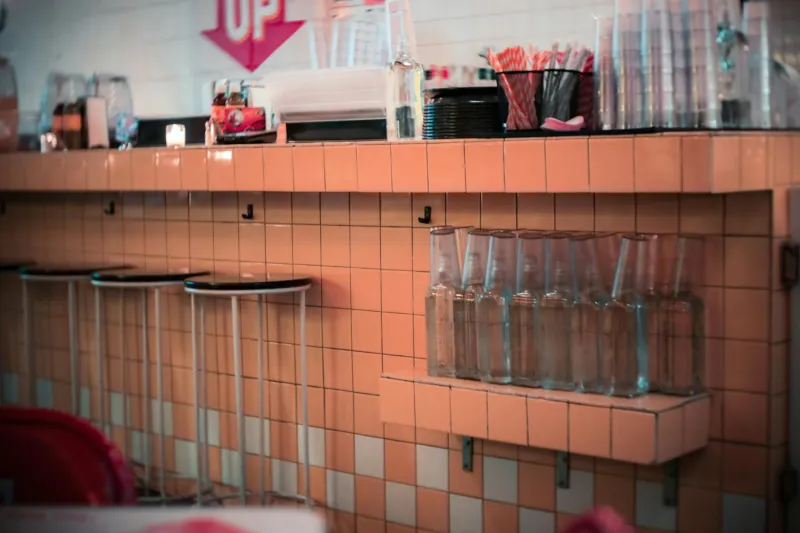
Smart pharmacists installed marble counters with swivel stools, creating America's first casual dining experience. Unlike saloons (which excluded women and children) or restaurants (which required formal dining), soda fountains welcomed everyone. A nickel bought you a seat at the social table of your community.
The result was revolutionary: a public space where different generations, social classes, and genders could interact naturally. Farmers discussed crop prices while their wives caught up on local news. Teenagers flirted over ice cream sodas. Business leaders held informal meetings over coffee floats. The soda fountain became the neutral territory where small-town America negotiated its social life.
The Democracy of the Counter
Unlike other social venues of the era, soda fountains operated on radically egalitarian principles. The lunch counter didn't care about your family name or bank account—everyone sat on the same stools, ordered from the same menu, and paid the same prices.
This democratic mixing had profound effects on American social development. Children learned to interact with adults as equals. Business relationships formed across class lines. Local politics played out in real-time conversations where every voice carried equal weight.
The soda jerk—usually a young man working part-time—became an informal social coordinator, remembering everyone's favorite drinks and facilitating introductions. "Have you met...?" was the most important phrase in the soda fountain vocabulary, connecting neighbors who might never have spoken otherwise.
The Teenage Embassy
For American adolescents, the soda fountain served as embassy to the adult world. Unlike school or home, where they were clearly subordinate, the fountain treated them as paying customers deserving of respect and service.
Teenagers developed their own fountain culture, complete with specialized vocabulary (a "black cow" was a root beer float), elaborate dating rituals (sharing a milkshake required serious commitment), and social hierarchies based on fountain knowledge rather than family status.
Parents tolerated and even encouraged this because the fountain provided supervised freedom. Their teenagers were socializing in public view, learning adult social skills under the watchful but not oppressive eye of the community.
The Information Exchange
Before radio and television dominated news distribution, soda fountains functioned as information clearinghouses. The pharmacist often doubled as informal newspaper editor, sharing medical advice, weather predictions, and political opinions with equal authority.
Regular customers developed sophisticated information networks. Farmers shared market prices and weather observations. Traveling salesmen brought news from other towns. Local business owners coordinated schedules and shared resources.
The fountain's central location—usually on Main Street—meant that anyone passing through town would likely stop for refreshment, bringing news from the outside world and taking local stories with them when they left.
The Modern Revival: Finding Community in Unexpected Places
While most drugstore fountains disappeared by the 1970s, a quiet revival is happening in unexpected corners of America. Small towns across the country are rediscovering the social power of the soda fountain, often as part of downtown revitalization efforts.
In Franklin, Tennessee, the restored Franklin Soda Works draws visitors from Nashville who don't quite understand why they feel so relaxed sitting at the vintage counter. In Bardstown, Kentucky, Hurst Drug Store has operated the same soda fountain since 1919, serving four generations of families who instinctively understand its social importance.
 Photo: Bardstown, Kentucky, via cdn.website-editor.net
 Photo: Franklin Soda Works, via www.tourisme-gaspesie.com
 Photo: Franklin, Tennessee, via static.vecteezy.com
These modern fountains attract customers seeking something they can't quite name—the experience of unhurried social interaction in a public space designed for lingering rather than efficiency.
What We Lost When We Gained Convenience
The decline of soda fountains coincided with the rise of suburban shopping centers, fast food, and chain drugstores focused on efficiency over community. We gained convenience but lost something harder to measure: spaces designed for spontaneous social interaction across generational and class lines.
Modern "third places"—coffee shops, breweries, co-working spaces—attempt to recreate this social function, but they often cater to specific demographics rather than entire communities. The soda fountain's genius was its universal appeal and democratic accessibility.
Finding the Survivors
A surprising number of authentic soda fountains still operate across America, hidden in plain sight in small-town pharmacies and restored downtown districts. They're marked by vintage signage, marble counters, and the distinctive sound of ice cream being hand-scooped into metal cups.
Many welcome curious visitors, especially those genuinely interested in the fountain's role in local history. Stop by with time to spare, order something you've never tried (perhaps a phosphate or an egg cream), and listen to the conversations around you.
You'll quickly discover that these survivors aren't just serving nostalgic treats—they're maintaining a social technology that modern America is slowly realizing it needs. In an age of digital connection and physical isolation, the humble soda fountain offers a reminder of what public space can be when it's designed for community rather than consumption.
The next time you're exploring small-town America and spot a vintage neon sign advertising "Fountain Service," consider it an invitation to step back into a social model that understood something important: democracy works best when it's practiced daily, over ice cream, in spaces where everyone is welcome.