When Congress Blamed the Machines: The 1930s Job Panic That Reads Like Today's AI News
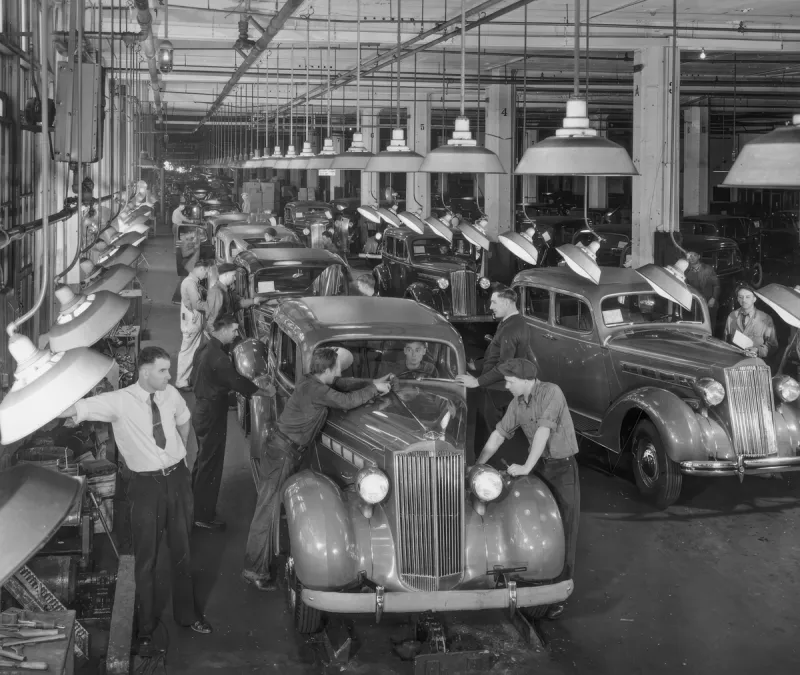
Photo: 1930s factory workers assembly line black and white vintage photo, via storage.googleapis.com
If you swapped a few words in a 1933 newspaper — replace 'machinery' with 'AI,' 'the machine age' with 'automation' — you'd swear you were reading last week's tech section. The fear that technology destroys jobs isn't new. It's practically a national tradition, and the first great American version of it happened during the Great Depression, when the country nearly rewrote its labor laws to fight back against machines.
The Panic That Had a Name
Economists in the 1930s had a term for it: 'technological unemployment.' The idea was simple and terrifying to a nation where one in four workers was jobless. If machines could do more work with fewer hands, and machines kept improving, wouldn't unemployment just keep climbing forever?
This wasn't a fringe worry. It appeared in mainstream magazines, radio broadcasts, and congressional hearings. Senator Hugo Black of Alabama became the face of the movement, arguing that because machines had made workers so productive, the sensible fix was to spread the remaining work around — by legally shortening the workweek.
The Bill That Almost Rewired American Life
In 1933, the Senate actually passed the Black-Connery bill, which would have made a 30-hour week the national standard. Think about that for a second. The federal government came within a House vote of permanently capping the American workweek — not as a wellness perk, but as a direct response to machines doing too much of the work.
The logic, laid out in the hearings, sounds startlingly modern. Witnesses testified about factories producing more goods than people could buy, about workers being 'displaced' by machinery while output soared. One witness after another argued that unless hours were cut, there simply wouldn't be enough jobs to go around. The New York Times covered the debate the way we now cover AI safety summits.
The bill ultimately stalled in the House, and the Roosevelt administration pushed alternative job programs instead. But the underlying anxiety never really resolved. It just went dormant.
The Same Arguments, on Repeat
Here's what makes the 1930s debate worth revisiting: nearly every argument you hear about AI today has a direct ancestor from that era.
- 'This time it's different — machines can now do the thinking.' In the 1930s, the claim was that machines had crossed a line by replacing skilled craftsmen, not just muscle. The line keeps moving.
- 'Productivity is up but wages aren't.' That exact complaint drove the 30-hour-week movement, using language almost identical to today's 'productivity-pay gap' op-eds.
- 'We need to slow the technology down.' Then it was legislative hour caps; now it's licensing regimes and moratorium letters. The instinct to pause the future is nearly a century old.
- 'New jobs will emerge — but who believes that?' Even in 1933, optimists pointed to entirely new industries born of older technologies. Skeptics weren't buying it then, either.
Even the cultural texture matches. Popular magazines of the Depression era ran fiction about robot-dominated futures. A 1930s term for the fear — 'the march of the machine' — was as ubiquitous in its day as 'AI takeover' is in ours.
What Actually Happened Next
So how did the panic end? Not the way either side predicted. The Depression ended, war production absorbed millions of workers, and postwar America exploded into new industries — aviation, television, plastics, suburbs full of new jobs nobody had imagined. The machines didn't destroy work. They changed what work looked like, slowly and messily, with real pain for specific workers in specific towns along the way.
That last part matters. The aggregate story — 'new jobs eventually appeared' — was true, but it was cold comfort to the machinist in a shuttered shop. The 1930s debate wasn't wrong to worry about people; it was wrong to assume the worry required stopping the machines.
The Lesson Hiding in the Archives
There's a strange comfort in knowing that America has been here before. The AI headlines of today — the displacement studies, the congressional hearings, the breathless magazine covers — are, in a sense, reruns. The country survived its first automation panic without capping the workweek at 30 hours, and it also survived the transition itself, imperfectly but completely.
The next time you read that this technological moment is unprecedented, it might help to picture a senator in 1933, standing on the Senate floor, warning that the machines had come for America's jobs — and nearly winning the argument. We've been having this exact fight for a hundred years. The outcome, both times, was more complicated and less apocalyptic than anyone predicted.