They Built a Neighborhood Underground in the Desert — And Nobody Noticed
They Built a Neighborhood Underground in the Desert — And Nobody Noticed
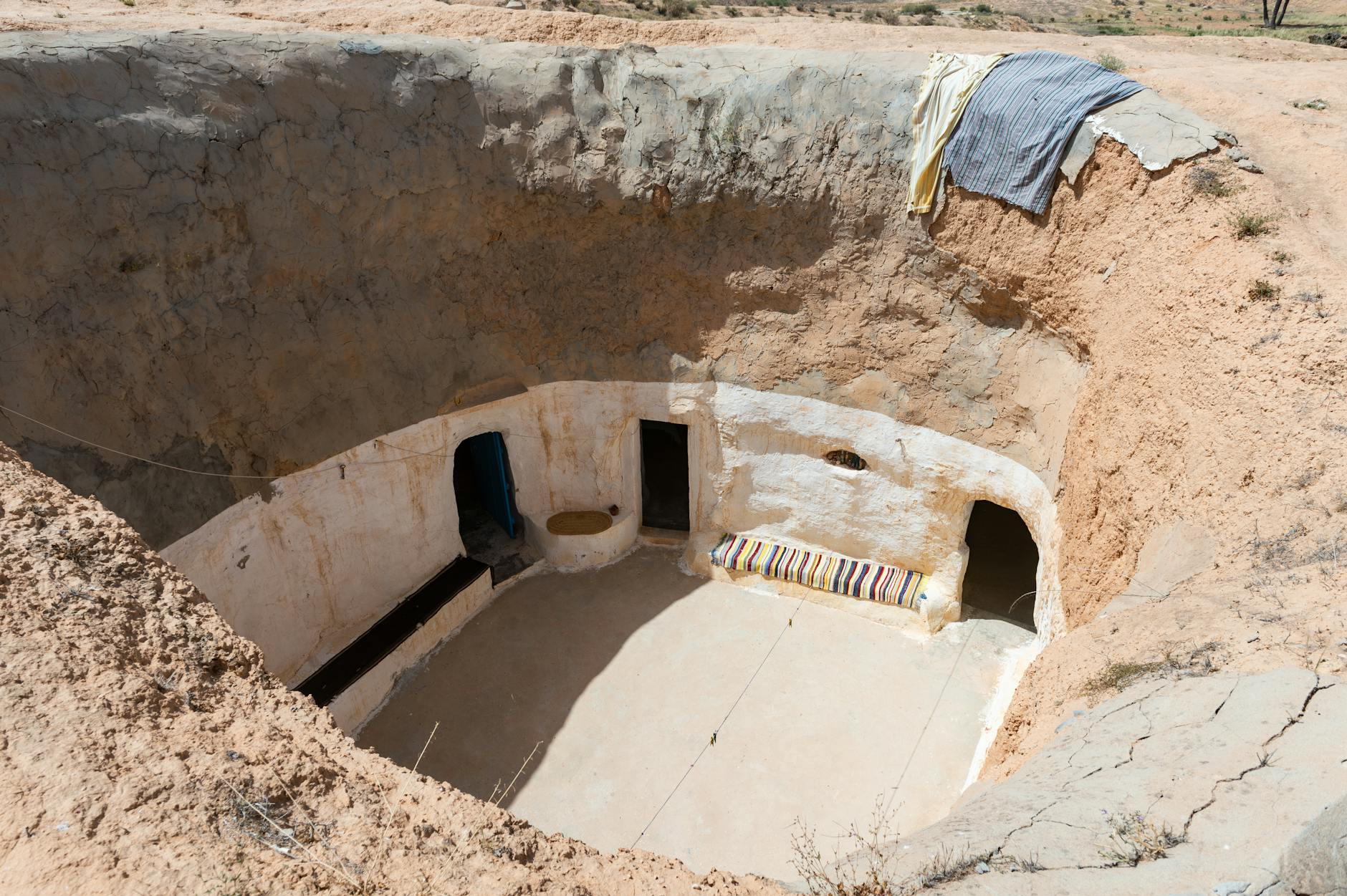
Somewhere in the baked red landscape of the American Southwest, a handful of families once made a decision that sounds more like science fiction than American history: they moved underground. Not into bunkers. Not as a survival stunt. Just quietly, practically, because the desert was trying to cook them alive — and they figured the earth itself might be the best air conditioner money couldn't buy.
This wasn't a government experiment. There were no architects with famous names attached. It was a community solving a problem that mainstream America had decided to solve with electricity and Freon instead.
The Heat That Started Everything
If you've never spent a July afternoon in the Sonoran or Mojave Desert, it's difficult to fully appreciate what 115-degree heat actually does to a building — and to the people inside it. Conventional above-ground structures in these regions absorb and radiate heat with remarkable efficiency. Air conditioning helps, but in the mid-20th century, it was expensive, unreliable, and completely dependent on a power grid that desert communities couldn't always count on.
So a small number of residents, inspired loosely by what opal miners in Coober Pedy, Australia had been doing for decades — carving livable homes directly into hillsides and sandstone outcroppings — started experimenting with the same idea on American soil. The logic was almost embarrassingly simple: dig down six to ten feet, and the surrounding earth maintains a near-constant temperature of around 55 to 65 degrees Fahrenheit year-round. No compressor required.
These weren't caves. Early iterations were carefully engineered earth-sheltered structures, with reinforced walls, ventilation shafts, and in some cases, south-facing windows cut into hillsides to allow natural light without direct sun exposure. By the 1960s and into the 1970s, small clusters of these homes existed in parts of New Mexico, Arizona, and southern Utah — quietly functioning, quietly comfortable, and almost completely invisible to the outside world.
Why Did Nobody Talk About It?
Here's where the story gets genuinely puzzling. This wasn't a fringe idea without merit. Studies from the era confirmed what residents already knew from experience: underground and earth-sheltered homes used a fraction of the energy required by conventional construction in extreme climates. The thermal mass of surrounding soil acted as a natural buffer, keeping interiors cool in summer and surprisingly warm in winter.
And yet, mainstream media barely blinked.
Part of the explanation is cultural. The postwar American dream was built on a very specific image — a house above ground, with a yard, a driveway, and a clear view of the sky. Underground living carried connotations that were hard to shake: poverty, eccentricity, survivalism. Real estate markets had no framework for valuing a home you couldn't photograph from the street.
There was also an economic dimension. The construction industry, utility companies, and appliance manufacturers had enormous financial stakes in the conventional model. A home that required almost no heating or cooling equipment wasn't a particularly attractive product to sell. So the idea didn't get championed. It just persisted quietly, in small pockets, kept alive by the people who actually lived in it.
The Quiet Influence It Left Behind
What's fascinating — and a little frustrating — is how directly these early American experiments connect to ideas that are now considered cutting-edge in sustainable design.
Earth-sheltered architecture has experienced a genuine renaissance over the past two decades, championed by green building organizations, featured in architecture publications, and increasingly incorporated into energy-efficient housing projects across the country. Concepts like passive thermal regulation, bermed construction, and subterranean insulation are now taught in university design programs as forward-thinking innovations.
Except they're not really innovations. They're rediscoveries.
Architectural historians who have dug into the record — pun intended — have found clear lineage between those mid-century desert communities and the principles now celebrated in modern eco-housing. The knowledge was there. The proof of concept was lived-in and functional. It just never made it into the mainstream conversation in time to matter.
What If We Had Actually Listened?
This is the part of the story that sticks with you. The United States spent the latter half of the 20th century building millions of homes in desert climates — Las Vegas, Phoenix, Tucson, Albuquerque — using construction methods that required enormous, ongoing energy consumption to remain livable. The infrastructure costs alone, the strain on power grids, the carbon footprint of cooling entire cities in environments that were never meant to support dense above-ground settlement — it's staggering when you add it up.
And sitting right there, largely unexamined, was a low-tech solution that a small group of Americans had already proven could work.
Today, as climate conversations grow louder and energy costs continue climbing, architects and urban planners are finally asking the questions that those desert communities answered fifty years ago. Earth-sheltered homes are being built in Nevada and New Mexico with considerable fanfare. Documentaries get made. Design awards get handed out.
Somewhere, the people who were doing this in quiet obscurity decades ago probably have complicated feelings about that.
The Lesson Worth Keeping
The story of underground living in the American Southwest isn't just a quirky historical footnote. It's a case study in how genuinely useful ideas get filtered out by culture, commerce, and aesthetics — and how the cost of ignoring them doesn't always show up right away.
The desert didn't change. The heat didn't get more polite. We just chose a more expensive, more fragile way to deal with it, and called it modern living.
Some ideas don't disappear when they're ignored. They just wait underground.