Before the Railroads, America Traveled by Water — And a Few of Those Routes Still Take Passengers
The Country That Moved by River
There's a version of American history that gets skipped in most travel conversations. Before the locomotive reshaped the country, before the Model T, before the interstate, America moved by water.
Not metaphorically — literally. The Mississippi River system alone connected more than 16,000 miles of navigable waterways through the interior of the continent. Steamboats carried passengers from Pittsburgh to New Orleans, from Cincinnati to St. Louis, from Louisville to Memphis, on journeys that took days and passed through a landscape that most people alive today have never seen from the water. Coastal routes linked Boston to New York, New York to Philadelphia, and the entire Eastern Seaboard in ways that made sea travel faster and more comfortable than any road available at the time.
At its peak in the mid-1800s, the American steamboat network was one of the most extensive passenger transportation systems in the world. It built cities. It moved armies. It carried Mark Twain, who was so shaped by the experience that he took his pen name from the riverboat depth-sounding call — mark twain, meaning two fathoms of water.
Then the railroads arrived. And within a few decades, most of that water-travel culture simply vanished.
What Actually Happened
The decline wasn't sudden, and it wasn't simple. Railroads were faster and more reliable than river travel, which was always at the mercy of water levels, ice, and the occasional catastrophic boiler explosion. (Steamboat explosions were genuinely common in the 19th century — the Sultana disaster of 1865, in which an overloaded steamboat on the Mississippi killed an estimated 1,700 people, remains the deadliest maritime disaster in US history, yet almost nobody knows about it.)
But speed wasn't the only thing that made railroads win. Trains could go where rivers couldn't. They opened up the interior of the continent in ways that river systems — which run where geography dictates — simply couldn't match. By the early 20th century, passenger steamboat service had declined dramatically on most major routes. By mid-century, it was largely gone.
What's remarkable is how completely this travel culture was erased from the popular imagination. Americans today think of themselves as a car culture, occasionally a train culture. Almost nobody thinks of the country as having had a water culture — even though rivers and coastal routes shaped where cities were built, where people settled, and how the economy developed for the first century of the republic's existence.
The Routes That Still Run
Here's where the story gets genuinely useful for travelers: a handful of authentic passenger water routes still operate in the United States, and they offer something that almost no other form of travel can — the experience of seeing the country from the water, at a pace slow enough to actually notice it.
The Washington State Ferry System is the largest in the US and one of the largest in the world, connecting Seattle with the San Juan Islands, the Olympic Peninsula, and multiple Puget Sound communities. For many passengers, these are commuter ferries — but for visitors, a crossing to Bainbridge Island or a longer run to the San Juans is a genuinely spectacular piece of travel that costs less than $20 and passes through some of the most beautiful maritime scenery in North America.
The Alaska Marine Highway System is something else entirely. Running more than 3,500 miles from Bellingham, Washington to Dutch Harbor in the Aleutian Islands, it connects dozens of communities in Southeast and Southwest Alaska that have no road access at all. This isn't a cruise — it's a working ferry system that carries cars, freight, and passengers on voyages that can last multiple days. Travelers can bring their own vehicle, sleep in cabins or on deck, and watch the Inside Passage unfold in a way that no road trip or flight could replicate. It's one of the most underrated travel experiences in the entire country.
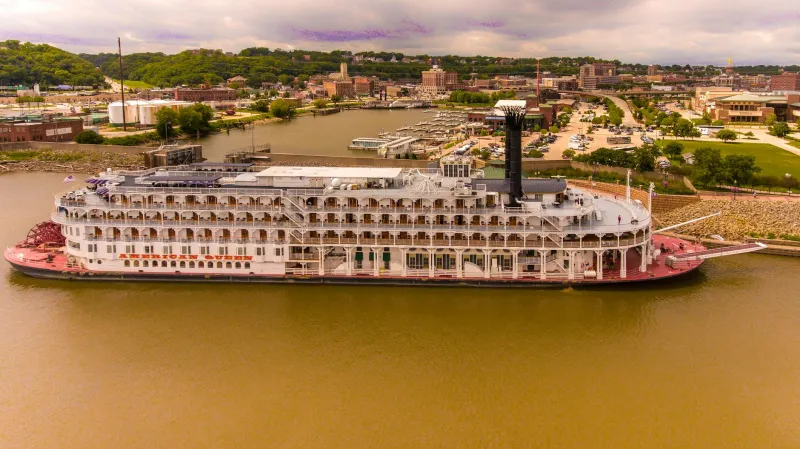
The American Queen Voyages and a small number of other riverboat operators still run multi-day passenger cruises on the Mississippi, Ohio, and Columbia rivers. These are the direct descendants of the steamboat era — paddle-wheel vessels that travel at roughly the same speed as their 19th-century predecessors, stopping at river towns that the interstate system bypassed entirely. Natchez, Mississippi. Paducah, Kentucky. Hannibal, Missouri. These aren't tourist constructions. They're real places that grew up around the river, and arriving by water is the way they were always meant to be approached.
The Steamship Authority in New England runs year-round ferry service between Cape Cod, Martha's Vineyard, and Nantucket — routes that have been operating in some form since the mid-1800s. The boats aren't glamorous, but the crossings pass through waters that were once among the busiest in the hemisphere, and there's something quietly powerful about that.
Why Traveling by Water Changes How You See Places
There's a specific quality to water travel that's hard to articulate until you've experienced it. Cities look different from their rivers. You see the back side of things — the industrial waterfronts, the old warehouse districts, the bridges and levees that defined how a place was built. The pace is slower in a way that isn't frustrating but genuinely contemplative.
And the landscape between cities — the parts that roads and airports skip entirely — is often the most revealing. The lower Mississippi River, seen from a slow-moving vessel, is a genuinely alien landscape: miles of floodplain, oxbow lakes, sandbars, and bottomland forest that looks essentially unchanged from what 19th-century travelers described. The Inside Passage in Alaska is a maze of fjords, glaciers, and forested islands that exists almost entirely outside the frame of conventional American travel.
The steamboat era built America in ways most people don't fully appreciate. A few of those routes still run. They're not hard to book. They're just not the trips anyone thinks to suggest — which, around here, is usually the sign that they're worth taking.